
AI LABOR CULTURE
Who Buys What We Build?
Feb 11, 2026
TL;DR: U.S. employers cut 1.2 million jobs in 2025 while posting record profits and pouring tens of billions into AI. The official number of AI-attributed layoffs — 55,000 — is almost certainly a fraction of the real total. Companies aren’t passing the savings to consumers; they’re sending them to shareholders. Meanwhile, 75% of households can’t afford a median-priced home, retirement savings are woefully inadequate, and CEO pay has risen 1,094% since 1978 while worker pay has risen 26%. AI didn’t break capitalism. It exposed a version of capitalism that had already stopped distributing its gains — and is now accelerating the collapse of the consumer base that the whole system depends on.
I was scrolling through LinkedIn this morning when I came across posts from recently laid-off Salesforce employees. The pattern was familiar: gratitude for the experience, pride in the work, optimism about the next chapter. One person even highlighted their role in implementing the very AI tools that, it turns out, made their position redundant.
Nobody was angry. Nobody pointed out the absurdity. And that silence says as much about where we are as the layoffs themselves.
The uncomfortable question hiding beneath the AI layoff headlines isn’t whether machines can do our jobs. It’s whether an economy built on mass consumption can survive once it systematically eliminates the incomes that make that consumption possible.
I’m not an economist. I’m a retired web developer who spent two decades watching technology reshape industries. The facts in this piece come from Federal Reserve data, Bureau of Labor Statistics reports, company earnings calls, and CEO interviews. You don’t need a PhD to connect them. You just have to be willing to look at them all.
The Numbers
The scale of job displacement in 2025 was staggering. According to Challenger, Gray & Christmas[1], U.S. employers announced 1,206,374 job cuts in 2025 — a 58% increase from 2024 and the highest annual total since the pandemic year of 2020. In tech alone, layoffs.fyi[2] tracked 783 separate layoffs affecting roughly 246,000 workers, averaging about 674 people per day.
And AI is no longer a background factor. Challenger’s data shows that AI was directly cited as the reason for 54,836 of those layoffs[1] in 2025, with over 71,000 AI-attributed cuts since tracking began in 2023. About 70% of global tech layoffs came from U.S.-headquartered companies[3].
Salesforce is a case in point. CEO Marc Benioff publicly insisted in August 2025 that AI would not lead to mass layoffs. Three weeks later, he confirmed on a podcast[4] that the company had cut its support workforce from 9,000 to about 5,000: “I’ve reduced it from 9,000 heads to about 5,000, because I need less heads.” The company’s total layoffs jumped from roughly 1,000 in 2024 to approximately 5,000 in 2025[5].
Microsoft followed the same playbook. The company laid off over 15,000 employees in 2025[6] — five consecutive months of cuts — while posting record revenue of $70.1 billion and net income up 18%. CEO Satya Nadella called this the “enigma” of layoffs during strong financial performance[6]. Company leaders rejected the suggestion that AI was directly eliminating jobs. But the same company was spending $80 billion on AI infrastructure[7], and a Microsoft finance executive admitted during a JPMorgan conference that the company was “saving hundreds of millions of dollars a year by using artificial intelligence for customer support and reducing the need for human interaction.”[8] The official reason for the layoffs was “restructuring.” The money trail tells a different story.
This is an important point about the data. Only about 55,000 of the 1.2 million layoffs in 2025 were officially attributed to AI. But that figure counts only the cuts where companies were honest enough — or careless enough — to say the word “AI” out loud. The preferred labels are “restructuring,” “strategic realignment,” “increasing agility,” “doing more with less.” These are companies that are simultaneously investing tens of billions in AI infrastructure, automating customer support, bragging about productivity gains on earnings calls, and telling investors they need fewer people. The time for giving them the benefit of the doubt on their layoff attributions has passed. The real AI-driven number is almost certainly far higher than what anyone is willing to put on a press release. And as Harvard Business Review noted in January 2026[9], many of these companies aren’t even cutting jobs because AI has proven it can replace those workers — they’re doing it based on AI’s potential. They’re firing people on a bet.
Early 2026 is tracking even worse. Tech layoffs are running at 856 people per day[2]. Meta cut 1,500 from Reality Labs. Amazon is shedding 16,000 corporate positions[3], bringing its combined recent cuts to about 30,000 — roughly 10% of its corporate workforce. January 2026 saw 108,435 announced job cuts[10], the worst January since 2009.
IBM’s CEO, Arvind Krishna, tried to frame this as a simple post-pandemic correction. Companies over-hired during the COVID boom, and now they’re normalizing.
But it doesn’t explain why the pace is accelerating four years after the pandemic, why companies posting record profits are cutting the deepest, or why the money saved on salaries is flowing directly into AI budgets.
The Productivity Trap
Here’s what the earnings calls celebrate: AI is making companies leaner. Fewer people, more output, better margins. From a shareholder perspective, this is exactly what it should be. Productivity gains are the engine of capitalism.
But capitalism has a structural requirement that nobody on those earnings calls wants to talk about. The system needs producers and consumers. These roles must be roughly in balance. When companies collectively eliminate the jobs that give people purchasing power, they’re optimizing themselves into a paradox — producing goods and services for a customer base that is steadily shrinking.
Henry Ford stumbled into this over a century ago. In January 1914, Ford announced he would pay workers $5 a day[11] — more than double the prevailing wage of $2.34 — for eight hours of work instead of nine. Economists have long debated the motivation. The popular story is that Ford wanted his workers to afford the cars they built. Critics counter that it was purely a retention move — turnover at Ford’s Highland Park plant had hit 380%[12] by late 1913 because workers couldn’t tolerate the monotony of assembly line work at poverty wages. To maintain a workforce of 14,000, Ford had to hire 52,000 people in a single year.
But these aren’t competing explanations. They’re two faces of the same problem. Workers were leaving because they couldn’t make a decent living at $2.34 a day. The wage was too low to sustain them, and therefore too low to sustain the business. When Ford doubled it, both problems resolved at once: turnover disappeared[12], productivity surged, profits doubled in under two years, and — as the Kellogg School of Management notes[13] — workers were boosted into the middle class with disposable income to buy the very Model Ts they were producing. Ford later called it “one of the finest cost-cutting moves we ever made.”
The lesson isn’t about Ford’s generosity or his business cunning. It’s that when workers can’t sustain a decent life, the system breaks — whether that shows up as 380% turnover in 1913 or collapsing consumer demand in 2026. Today’s tech companies aren’t losing workers to turnover. They’re eliminating workers entirely. But the underlying economic reality is the same. If people can’t make a living, the whole arrangement falls apart. Ford figured that out with a longer time horizon than a quarterly earnings report. We seem to have forgotten it.
The Professional-Class Buffer
What struck me about those LinkedIn posts from Salesforce employees was the composure. Laid-off workers performing gratitude and resilience on a platform owned by Microsoft, which itself laid off more than 10,000 people in recent rounds. It’s a survival mechanism, and an effective one. Showing anger or bitterness makes you unhireable in a market that demands positivity.
And for now, it works. These are people with savings, severance packages, professional networks, and in-demand skills. They can absorb the hit and land somewhere, maybe at a lower salary, maybe in a less stable role. The professional class has a buffer.
But there’s a compounding effect that doesn’t get enough attention. Each round of layoffs chips away at something. The first time, you bounce back. The second time, you’re more cautious. The third time, you start questioning the arrangement itself. And with AI accelerating the cycle, the intervals between disruptions are getting shorter while the recovery periods are getting longer — especially for people over 40.
According to Fortune’s analysis of Glassdoor data[14], employee mentions of “layoffs” and “job insecurity” in company reviews are now higher than they were in March 2020, when the pandemic first shut down the global economy. Trust in senior leadership has eroded sharply, with negative descriptions of executives rising since 2024. The era of “forever layoffs,” as Glassdoor calls it, is redefining the professional workplace less by empowerment than by chronic insecurity.
The professional-class buffer runs out when the landing spots disappear. When the next company is also “doing more with less.” When the freelance market is saturated. When the skills you spent years building are commoditized overnight by the same tools you helped implement.
The Longer Arc
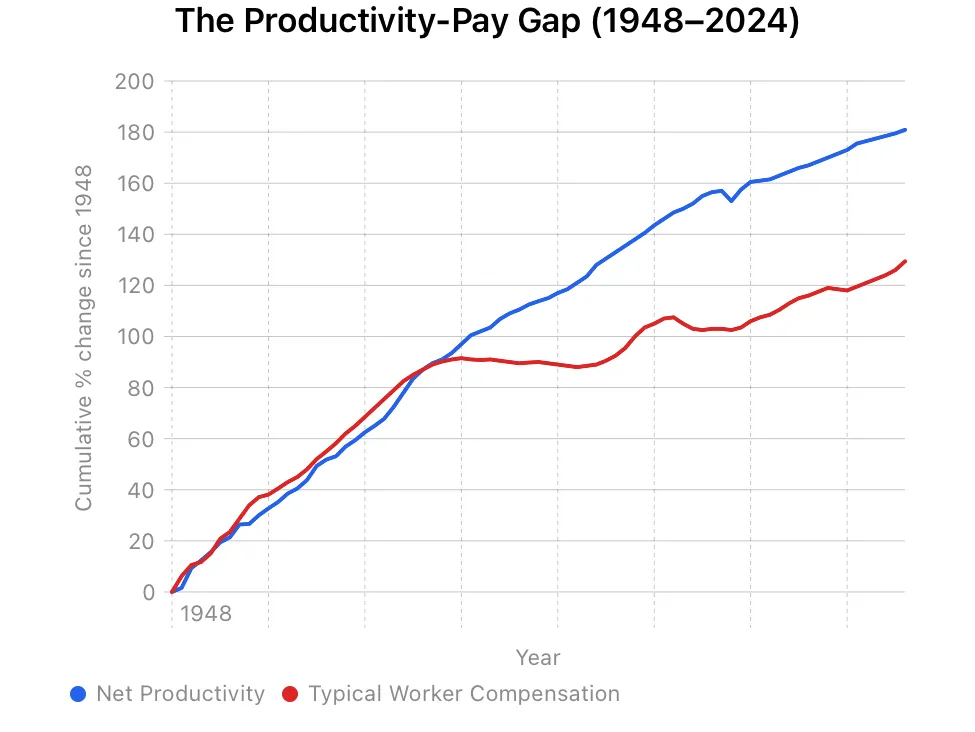
This isn’t just an AI story. It’s the latest chapter in a trend that’s been building since the late 1970s. According to the Economic Policy Institute[15], worker pay and productivity grew in lockstep from the end of World War II through the 1970s. Then they diverged. From 1979 to 2024, worker productivity increased 80.9% while average hourly compensation grew just 29.4%[16]. The EPI attributes this to deliberate policy choices: the erosion of unions, deregulation, corporate globalization, declining minimum wages, and tax cuts for high earners.
Economists will debate the methodology behind those numbers — which inflation deflator to use, whether to count benefits alongside wages, how to measure productivity across sectors. Let them debate. The lived reality isn’t ambiguous. Nearly 75% of U.S. households[17] cannot afford a median-priced new home. Owning a median-priced house now consumes 47% of median household income[18] — far above the 30% threshold considered affordable. Fifty-five-year-olds have median retirement savings under $50,000, and 58% of American workers[19] say their retirement savings are behind where they should be. Meanwhile, the stock market is at record highs and CEO compensation has climbed to 281 times the typical worker’s pay[20] — up from 21-to-1 in 1965. Since 1978, CEO pay has risen 1,094%. Worker pay has risen 26%. You don’t need a PhD in economics to see that the gains from decades of rising productivity have not been flowing to the people who produced them. Whatever the precise measurement, the direction is unmistakable.
The wealth concentration data is just as stark. Federal Reserve data[21] shows that the top 1% of U.S. households owned 31.7% of all wealth in the third quarter of 2025 — the highest share on record since tracking began in 1989. The wealthiest 1% held about $55 trillion in assets, roughly equal to the wealth held by the bottom 90% combined. Meanwhile, the bottom 50% of households held just 2.5%[22] of the nation’s wealth.
Some will object that these numbers overstate the problem — that when you include retirement accounts and home equity, many Americans are technically “millionaires.” On paper, maybe. But this isn’t 1950, when a million dollars meant generational security. A serious illness can cut those paper assets in half overnight. According to the CFPB, 100 million Americans carry a combined $220 billion in medical debt[23]. An estimated 31 million Americans borrowed money for healthcare in 2024 alone — $74 billion worth[24]. Medical bills remain the primary cause of roughly two-thirds of personal bankruptcies[23]. If your portfolio is worth $50 million and you face a $500,000 medical crisis, that’s expensive but it doesn’t change your life. If your retirement savings are $400,000 — which puts you ahead of most Americans — that same crisis cuts your future in half. The wealth that looks adequate on a spreadsheet is one bad diagnosis away from inadequate. And that’s before we even get to the layoff.
Consumer spending patterns already reflect this divide[21]: the top 10% of income earners now account for nearly half of all U.S. consumer spending. The economy is increasingly dependent on a thin layer of wealthy households to drive demand — a fragile arrangement.
The standard counterargument from the billionaire class is that they create jobs and drive innovation. A rising tide lifts all boats. But the data above tells a different story. The tide has been rising for capital owners and receding for everyone else for nearly five decades. AI didn’t break capitalism. It exposed a version of capitalism that had already stopped distributing its gains. The displacement we’re seeing now is an acceleration of a trend that was well underway before anyone had heard of a large language model.
What makes this automation wave different from previous ones is both speed and breadth. The shift from agriculture to manufacturing took generations. The transition from manufacturing to services took decades. AI is hitting white-collar knowledge work, creative work, and service work simultaneously, and it’s doing it in years, not decades. The social systems that might cushion the blow — retraining programs, safety nets, policy responses — operate on timescales that simply can’t keep up.
The standard reassurance is that new jobs will emerge, just as they always have. The automobile displaced the horse and buggy, but it created mechanics, highway engineers, gas station attendants, and suburban real estate agents. That’s true. But it’s also not what’s happening this time. Every previous wave of automation replaced one kind of human labor with another. Machines replaced physical work, so people moved into services. Computers automated calculation, so people moved into knowledge work. There was always a next rung on the ladder. AI is different because it doesn’t replace one category of human work — it compresses the entire value chain.
Consider what’s actually happening in specific professions. A senior attorney at a law firm used to assign preliminary case research to a team of junior associates. That work is now done by AI in a fraction of the time. The senior attorney is fine — for now. But the junior associate positions that used to train the next generation of senior attorneys are disappearing. The pipeline that creates expertise is being cut. The same pattern holds in software development: a senior engineer defines the architecture and requirements, and AI implements, tests, and deploys the code. The mid-level and junior developer roles that used to be the training ground are evaporating. In web design — a field I’ve worked in for over two decades — I’ve watched AI tools grow from novelties to genuine replacements over just the past two years. There is nothing in the trajectory that suggests a meaningful role will remain for a human designer. Each new release closes another gap.
This is not a parallel to the Industrial Revolution, where physical labor was replaced by service work. We are not moving workers from one column to another. We are taking the human out of the equation entirely in profession after profession, and we are doing it from the bottom up — eliminating the entry-level and mid-career positions first, hollowing out the ladder while the people at the top look down and say the view hasn’t changed. It has no precedent in economic history, and the cheerful insistence that “new jobs will emerge” is not an argument. It’s wishful thinking!
And What Are the Billionaires Saying?
A handful of them see the problem clearly. Ray Dalio, founder of the world’s largest hedge fund, has been sounding the alarm for years. Back in 2018, he wrote that capitalism is not working for the majority of Americans[25] and called for a national emergency to be declared. More recently, at the Fortune Global Forum in October 2025[26], he warned that the bottom 60% of Americans are becoming an “extreme dependency” underclass, unable to participate meaningfully in the economy while the top 1-10% reap virtually all the gains from AI. He explicitly called for a redistribution policy[27] — though he qualified it by saying that handing money to “useless” people isn’t the answer either, a framing that tells you something about how even the most clear-eyed billionaires think about the rest of us.
Sam Altman, the CEO of OpenAI and arguably the person most responsible for the current AI wave, has called AI an “equalizing force in society”[28] and has floated universal basic income. But when pressed directly on wealth inequality[29] at a San Francisco event — confronted with Jensen Huang’s $179 billion net worth while 42 million Americans were losing food assistance — he redirected to housing policy and said the economic system is “so deeply screwed up” but that fixing it is “really hard.” Not exactly a call to action from someone whose technology is accelerating the disruption.
Warren Buffett has put it most plainly: “This has been a prosperity that’s been disproportionately rewarding to the people on top.” But even his observation stays descriptive rather than prescriptive.
That’s about it for genuine acknowledgment. A few billionaires who can read the data but aren’t willing to fundamentally challenge the system that made them.
Their actions, however, tell a different story. Media theorist Douglas Rushkoff documented this brilliantly in Survival of the Richest[30]. The book opens with what has become a famous anecdote: Rushkoff was invited to a desert resort to advise five billionaires on “the future of technology.” Instead, the entire session devolved into a single question[31] — how do I maintain authority over my security force after “the Event”? They called it “the Event,” their euphemism for environmental collapse, social unrest, or whatever catastrophe they consider inevitable. Rushkoff’s advice was straightforward: treat people well now, expand that ethos to your business practices and wealth distribution, and there’s less chance of an “Event” in the first place. They weren’t interested.
The bunker industry tells you where the money is actually going. Zuckerberg is building a $270 million compound on the Hawaiian island of Kauai[32] — 1,400 acres, a 5,000-square-foot underground bunker, self-sustaining food and water systems, staffed by hundreds of locals under NDAs. Peter Thiel secured a New Zealand passport and tried to build an underground lodge on the South Island. LinkedIn’s Reid Hoffman openly admits to owning “apocalypse insurance” properties[33], especially in New Zealand. Larry Ellison, co-founder of Oracle, bought almost the entire Hawaiian island of Lanai. Companies like Survival Condo, Oppidum, and Vivos[34] are doing booming business selling luxury underground residences with swimming pools, cinemas, and artificial sunlight — business that spiked after the pandemic and hasn’t slowed down.
Even OpenAI’s co-founder Ilya Sutskever reportedly said, “We’re definitely going to build a bunker before we release AGI.”
The contrast is stark. In their speeches and podcasts, a few billionaires acknowledge the gathering storm. In their actions, they’re building lifeboats for themselves and their families. They’re not investing in solutions for society — they’re investing in escape plans. As Rushkoff observed, these are people who feel “utterly powerless to influence the future” despite being the wealthiest and most powerful humans alive. They’ve concluded that the system they built and benefited from is heading toward collapse, and their response is not to change course but to make sure they survive the wreck.
That tells you everything about where we stand.
What Comes Next
There is one more argument worth addressing, because it’s the most seductive. The claim is that AI will lower the cost of goods and services so dramatically that even people with diminished incomes will be able to afford more. Healthcare, legal services, education, software — all of it gets cheaper as AI takes over the expensive human parts. In this telling, wages don’t matter as much because everything costs less.
It’s a nice theory, and it might even be partially true for some goods for some period of time. But it has a fundamental problem: it assumes that the companies deploying AI will pass the savings on to consumers rather than capture them as profit. We’ve already seen how this plays out. Microsoft saved hundreds of millions replacing customer support with AI and didn’t lower the price of Office 365. Salesforce cut its support workforce nearly in half and subscription prices held. The savings went to the bottom line. The entire premise of the cost-deflation argument depends on corporate benevolence that has no precedent and no mechanism to enforce it. And even if prices did fall, they would have to fall faster and further than incomes — for decades — to keep the consumer economy intact. That’s not an economic model. That’s a fantasy about the generosity of monopolists.
There are a few possible trajectories.
The optimistic case is that new kinds of work emerge, as has happened with every major technological shift in history. AI handles the drudgery, and humans move into roles we can’t yet imagine. Maybe. But even optimistic forecasts from major consulting firms show that AI adoption concentrates output into fewer firms and fewer roles. That’s not a job-creation engine. It’s a consolidation engine. The gap between displacement and new opportunity could be brutal, and there’s no guarantee the new roles will employ as many people or pay as well.
Another possibility is deliberate intervention. The levers exist: income floors like universal basic income or a negative income tax, aggressive taxation of AI-driven productivity gains, public ownership stakes in AI infrastructure, shorter work weeks to distribute remaining employment more broadly, or a revival of organized labor power to give workers a seat at the table where these decisions are made. None of these ideas are new. All of them are politically difficult in a country that can barely pass a budget. But they may become economically necessary if consumption craters — and some combination of them is more plausible than the fantasy that the market will sort this out on its own.
The third case is the dark one. Companies optimize for short-term shareholder returns, hollow out their customer base, and the system enters a deflationary spiral. Demand drops, revenues follow, more layoffs ensue. The feedback loop runs in reverse.
History suggests that extreme wealth concentration doesn’t resolve itself quietly. The Gilded Age led to the Progressive Era and the New Deal. The French aristocracy didn’t see it coming either. The question isn’t really whether a correction happens, but what form it takes and how much damage accumulates before it does.
The Silence
What concerns me most right now and what prompted this post isn’t the layoffs themselves. Disruption happens, and some of it may actually be necessary. What concerns me is the silence. The performed gratitude on LinkedIn. The euphemistic language of “strategic realignment” and “doing more with less.” The absence of a serious public conversation about what happens when the machines that boost productivity also eliminate the incomes that drive demand.
The people being laid off from Salesforce and Amazon and Meta aren’t abstractions. They’re engineers, writers, analysts, and support staff who did their jobs well and got thanked for it with a severance check and an NDA. Many of them helped build the very systems that replaced them.
Sooner or later, the good face to the bad game stops working. When the professional-class buffer is gone, when the savings are spent, when the network can’t find you another landing spot — that’s when the conversation changes.
For now, LinkedIn is full of gratitude posts. One day it will be full of something else. The question is whether we start that conversation now, while there’s still room for orderly course correction, or wait until the math forces it on us in ways that are far less comfortable for everyone.
This essay was also published on SubStack.
Update Mar 1, 2026
Jack Dorsey just cut 4,000 people from Block — nearly half the company.
His explanation: “We’re not making this decision because we’re in trouble. Our business is strong. Gross profit continues to grow.”
The stock jumped 24%.
A profitable company reduces labor, the market rewards it, and profits rise. That seems to be the logic.
This is the same pattern everywhere. Microsoft saved hundreds of millions by replacing customer support with AI, cut over 10,000 jobs, reported record profits — and didn't lower the price of Office 365 by a cent. Salesforce cut support staff by nearly half and raised prices.
Two days ago I published "The Corporate Benevolence Fantasy," which examines why AI-driven productivity gains won't trickle down — and why the K-shaped economy keeps splitting further apart. Block just provided the latest case study.
Dorsey says most companies will reach the same conclusion within a year. He's probably right. So here we go again: who buys what we build when the builders are gone?
Sources
[1] Challenger, Gray & Christmas, “2025 Year-End Report: Highest Q4 Layoffs Since 2008.” Annual job cut data (1,206,374 total) and AI-attributed layoff figures (54,836 in 2025; 71,000+ since 2023).
[2] Layoffs.fyi / TrueUp layoff tracker. Tech-sector layoff counts: 783 events affecting ~246,000 workers in 2025; 856 per day in early 2026.
[3] InformationWeek, “2026 Tech Company Layoffs.” About 70% of global tech layoffs from U.S.-headquartered companies; Meta Reality Labs and Amazon corporate cuts.
[4] CNBC, “Salesforce CEO Confirms 4,000 Layoffs,” September 2025. Marc Benioff podcast interview confirming support workforce reduction from 9,000 to ~5,000.
[5] SalesforceBen, “How Bad Were Tech Layoffs in 2025?” Salesforce layoff totals rising from ~1,000 in 2024 to ~5,000 in 2025.
[6] GeekWire, “Microsoft CEO Addresses Enigma of Layoffs Amid Record Profits.” Over 15,000 Microsoft layoffs in 2025; Satya Nadella memo on the “enigma” of cuts during record revenue ($70.1B) and 18% income growth.
[7] Windows Central, “Microsoft’s 2025 Layoffs Revolve Around Its $80 Billion AI Infrastructure Investment.”
[8] WealthWaggle, “Microsoft Layoffs 2025: Operator Lessons.” Microsoft finance executive at JPMorgan conference on “saving hundreds of millions” through AI customer support.
[9] Harvard Business Review, “Companies Are Laying Off Workers Because of AI’s Potential, Not Its Performance,” January 2026.
[10] Yahoo Finance, “Last Month Was the Worst January for Layoff Plans Since 2009.” January 2026: 108,435 announced job cuts.
[11] The Henry Ford Museum, “Ford’s Five-Dollar Day.” January 1914 announcement of $5/day wages.
[12] NPR, “The Middle Class Took Off 100 Years Ago — Thanks to Henry Ford.” Highland Park plant turnover at 380%; 52,000 hires needed for 14,000 positions; turnover disappearing after wage increase.
[13] Kellogg School of Management, “Henry Ford’s Five-Dollar Day.” Workers boosted into the middle class with disposable income to buy Model Ts.
[14] Fortune, “Forever Layoffs: Job Security in a K-Shaped Economy,” December 2025. Glassdoor data on employee mentions of “layoffs” and “job insecurity” exceeding March 2020 levels.
[15] Economic Policy Institute, “The Productivity–Pay Gap.” Postwar productivity-pay lockstep through the 1970s, then divergence driven by policy choices.
[16] Inequality.org, “Income Inequality.” Worker productivity up 80.9% vs. compensation up 29.4% from 1979 to 2024.
[17] NAHB, “Priced Out: The Affordability Pyramid,” March 2025. Nearly 75% of U.S. households unable to afford a median-priced new home.
[18] EconoFact, “Prospects for Improving Housing Affordability.” Median-priced home consuming 47% of median household income.
[19] Bankrate, “Retirement Savings Report.” 58% of American workers report retirement savings behind schedule.
[20] Economic Policy Institute, “CEO Pay.” CEO-to-worker pay ratio at 281:1, up from 21:1 in 1965. CEO pay up 1,094% since 1978; worker pay up 26%.
[21] CBS News / Federal Reserve, “U.S. Wealth Gap Widest in Three Decades.” Top 1% owning 31.7% of all wealth (Q3 2025), ~$55 trillion in assets. Top 10% accounting for nearly half of all consumer spending.
[22] Inequality.org, “Billionaire Wealth Concentration Is Even Worse Than You Imagine.” Bottom 50% of households holding just 2.5% of national wealth.
[23] Cornell ILR / Scheinman Institute, “How Medical Debt Is Crushing 100 Million Americans.” CFPB data: 100 million Americans carrying $220 billion in medical debt; medical bills as primary cause in roughly two-thirds of personal bankruptcies.
[24] Gallup, “Americans Borrow Estimated $74 Billion for Medical Bills in 2024.” 31 million Americans borrowing for healthcare in a single year.
[25] CNBC, “Bridgewater’s Dalio Posts on AI, Wealth Gap, Capitalism,” July 2018. Dalio calling for a national emergency over capitalism’s failure to work for the majority.
[26] Quartz, “Ray Dalio on Economy and Income Inequality.” Fortune Global Forum, October 2025. Warning about bottom 60% becoming an “extreme dependency” underclass.
[27] Yahoo Finance, “Ray Dalio Calls for Wealth Redistribution.”
[28] Fortune, “Sam Altman Told Me AI Should Be an Equalizing Force,” February 2026.
[29] SFGate, “Sam Altman Grilled on Wealth Inequality.” San Francisco event confrontation over Jensen Huang’s net worth and food assistance cuts.
[30] Douglas Rushkoff, Survival of the Richest, W.W. Norton, 2022.
[31] Douglas Rushkoff, “Survival of the Richest,” original essay. The desert resort anecdote: five billionaires asking how to maintain authority over security forces after “the Event.”
[32] The Conversation, “Billionaires Are Building Bunkers and Buying Islands.” Zuckerberg’s $270M Kauai compound: 1,400 acres, underground bunker, self-sustaining systems.
[33] Interesting Engineering, “Tech Billionaires Building Doomsday Bunkers.” Reid Hoffman on “apocalypse insurance” properties in New Zealand.
[34] CBC News, “Billionaire Bunkers: Doomsday.” Survival Condo, Oppidum, and Vivos luxury underground residences