
AI LABOR CULTURE
That's Just How It Is
May 14, 2026
Writing about AI and labor replacement, I kept comparing what was happening in the United States to what I had seen growing up in Germany. I trained as an electrician apprentice and watched a strike from the inside, every worker walking out together to protest unfair conditions. Later, after engineering school and a development-engineering role, I was already somewhat removed from unions. When I emigrated to Silicon Valley, I stopped seeing myself as a worker entirely. The interest in how American workers are organized, and why certain things have happened the way they have, is a recent development starting with Who Buys What We Build.
Questions kept surfacing. What caused the K-curve? Why don't American workers organize against the way they are being exploited? I never put the larger picture together. So I dug deeper. Here is what I found.
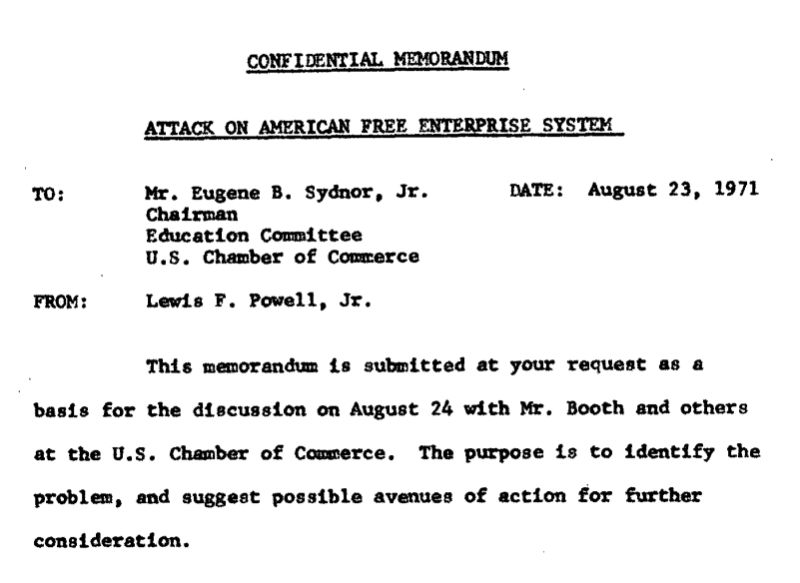
On August 23, 1971, a corporate lawyer named Lewis Powell sent a confidential memorandum to Eugene Sydnor at the U.S. Chamber of Commerce. Two months later, Richard Nixon nominated Powell to the Supreme Court. The memo was titled "Attack on American Free Enterprise System." It was confidential when written. Jack Anderson exposed it in his Washington Post column in September 1972, after Powell was already on the Court. [1] In the memo's candor, we can see what business strategy looked like when business thought no one was watching.
Powell's diagnosis was that American business had been losing the ideological argument. The universities had moved against the corporation. So had the courts, the press, mainstream politicians, and the educated middle class. Powell read the threat as the consensus of educated opinion moving against the corporation.
His remedy was a counter-mobilization across every front where the argument had been lost. Build think tanks to produce intellectual content sympathetic to business. Place sympathetic scholars in universities. Build litigation arms to take cases to courts on behalf of business interests. Organize politically through the Chamber and through new business federations. Treat the universities as terrain to be contested rather than ceded. Treat the courts as a strategic asset.
The memo named the timeframe as decades. The intellectual battle was lost in the short term. Recovery would require sustained, patient investment across multiple institutions over a generation. That patience turned out to be the project's defining feature.
What Powell will not engage in his memo is what businesses had been doing that produced the consensus he treats as ideological aggression. He names Ralph Nader as a representative figure of the attack but never asks why Nader exists. He writes as though the regulatory infrastructure of the late 1960s and early 1970s appeared from nowhere, generated by intellectuals who dislike capitalism, rather than from corpses and poisoned water tables.
The 1971 context grounds what Powell will not name. Leaded gasoline. The Corvair. Two decades of cigarette companies lying about lung cancer. [9] Defense-contractor profiteering. Rivers literally catching fire. OSHA was signed into law in 1970 because workplace deaths were that bad. The EPA was created the same year. None of this gets named in the memo. The regulatory response is treated as the problem; what produced it is treated as not worth engaging with.
The "social responsibility" claim does the rhetorical work that holds the inversion together. Powell does not argue that businesses should not have social obligations. He claims they already fulfill them. That move lets him appear reasonable while resisting every accountability mechanism that would test the claim. Flint, PFAS contamination, Cancer Alley, opioids: these are what "social responsibility" claims look like once the enforcement Powell was undermining gets gutted. The corporation pays a settlement, calls it a learning experience, and continues operating. Powell's framework treats this as the normal cost of doing business and treats anyone who objects as the actual problem.
The memo brought into focus what had been an undercurrent. Mont Pelerin had existed since 1947; the Friedman and Hayek framework was already known; family fortunes were already seeking political vehicles; and the Goldwater coalition's failed 1964 attempt had shown that a political constituency existed. None of it was coordinated. None operated at scale. Powell named what was already there, gave it strategic shape, and told the Chamber of Commerce specifically what to do about it. The undercurrent became a program.
The institutions went up fast. Business Roundtable, 1972, organized the CEOs of the largest American corporations into a single political body. Heritage Foundation, 1973, funded initially by Joseph Coors and Richard Mellon Scaife. The American Legislative Exchange Council, also in 1973, drafted model legislation for sympathetic state legislators. Cato Institute, 1977, funded by Charles Koch. The Federalist Society, 1982, was building a national network of conservative law students and faculty. The State Policy Network, 1992, eventually coordinated sixty state-level think tanks. By 2000, the institutional architecture Powell had recommended in 1971 was operational and producing output.
The funding came from a small number of large foundations. Richard Mellon Scaife's family money funded Heritage, the American Spectator, and dozens of smaller operations. The Bradley Foundation in Milwaukee funded academic chairs and litigation. The Olin Foundation paid for the original law-and-economics movement at Harvard, Chicago, and Yale. Coors paid for Heritage's startup. Koch built a parallel network through Cato and, later, the Mercatus Center. They operated quietly, hidden in plain sight, waiting for the conditions to change. [2]
The conditions changed in 1978. A Labor Law Reform Act that would have made union organizing easier was defeated in the Senate by filibuster despite Democratic control of both chambers and the White House. It was the moment the business mobilization Powell had recommended in 1971 first showed it could win against organized labor in a Democratic Washington. By 1980, the policy turn was already underway. Reagan accelerated it. The Reagan administration's deregulatory program drew its talking points directly from Heritage's Mandate for Leadership, a 1,100-page blueprint published before the inauguration.
This is the moment the K-curve opens. Worker productivity and pay rose in lockstep from the end of World War II through 1979. After 1980, they decoupled. From 1979 to 2025, productivity grew 90.2 percent while typical worker pay grew 33.0 percent. [4] The income going to the bottom 80 percent stagnated. The top accelerated. Two trajectories, same economy.
The infrastructure that was built quietly produced specific policy.
Labor power was reduced. Reagan fired 11,000 air-traffic controllers in 1981, signaling that breaking unions had become acceptable. Right-to-work laws spread to 26 states across the South and Midwest. Janus v. AFSCME extended right-to-work to public-sector unions in 2018. Union density fell from 35 percent in the 1950s to roughly 10 percent now. [10]
Top tax rates were cut. The top marginal income tax rate dropped from 70 percent in 1980 to 28 percent after Reagan's 1986 reform. Bush in 2001 and 2003 preserved the new lows. The 2017 corporate cut dropped the corporate rate from 35 percent to 21 percent. Capital gains continued to be taxed at a lower rate than ordinary income.
Antitrust enforcement was abandoned. Robert Bork's The Antitrust Paradox (1978) reframed antitrust law as concerned only with consumer prices. The Reagan Justice Department adopted the doctrine; the Federalist Society judicial pipeline embedded it. Mergers concentrated industries across retail, banking, telecom, agriculture, healthcare, and tech. Four firms now control roughly 80 percent of US beef processing; meatpacking jobs that were union and middle-class in the 1970s are now non-union and pay well below the inflation-adjusted 1970s wage. The resulting labor market concentration directly suppressed wages. [8]
The financial side was rewired. SEC Rule 10b-18, adopted in 1982, made stock buybacks legal. Shareholder primacy became the operating doctrine of American corporate management. In 2024, S&P 500 companies returned $1.6 trillion to shareholders in dividends and buybacks. [5]
These were the levers. The K-curve is what they produced when pulled together over forty years.
Globalization and technology happened during the same forty years. They made business more profitable. CEO compensation rose from roughly 30 times the average worker's pay in 1980 to several hundred times in 2000. [7] Worker pay did not move. Globalization and technology are the conditions through which the political distribution operates. Germany faced the same global trade and the same technology curve. German worker compensation tracked productivity more closely because the architecture distributed the gains differently.
The pattern continues. In 2025, the same network produced Project 2025, the 922-page playbook the current administration is implementing in real time. Schedule F, which lets the administration fire tens of thousands of federal civil servants at will, was revived in the first weeks of the new term. The Department of Education is being dismantled by executive order. The institutions Powell recommended in 1971 are the same institutions that wrote the document running the federal government in 2026. [3]
The labor side could not organize an equivalent response.
The Wagner Act of 1935 gave American workers the right to organize, but it locked the unit of bargaining inside the individual firm. Workers vote to certify a union for a specific bargaining unit inside a specific employer. The union represents those workers, at that employer, exclusively. There is no provision for industry-wide or sectoral bargaining. Every fight has to be won, employer by employer.
The German Tarifvertrag system I knew works the other way. Wage and working conditions agreements are negotiated at the sector level and bind all employers in the sector. A retailer in Hamburg and a retailer in Munich operate under the same negotiated terms. Deloitte Germany cannot unilaterally cut family leave for admin staff. The floor is set somewhere above the firm. Codetermination, Mitbestimmung, puts worker representatives on company boards. The Sozialstaatsprinzip in the Basic Law of 1949 makes worker protection a constitutional principle. An ordinary political majority cannot repeal these arrangements.
The American firm-based architecture means leverage has to be rebuilt firm-by-firm every time the market tightens, and is lost firm-by-firm every time the market loosens. Union density was 35 percent in the 1950s and is around 10 percent now. The decline is what happens when the structure is built to require continuous reorganizing at the firm level, and the other side, with patient, coordinated funding, spends fifty years making that reorganizing harder.
The Taft-Hartley Act of 1947 further tightened the framework. It outlawed the closed shop. It allowed states to pass right-to-work laws, preventing unions from collecting dues from workers the unions are required by law to represent. It banned secondary boycotts, the tactic that lets workers at one company support a strike at another. It required union officers to sign anti-communist affidavits, which the CIO used to expel its most disciplined organizers. By 1955, the American labor movement had been reduced to bread-and-butter wage bargaining at individual firms. Any political action was closed off.
This is the structural answer to why American workers do not organize against the conditions they face. The architecture was built to make organizing happen one firm at a time, but was later weakened, making even firm-level organizing difficult. Meanwhile, the side with patient coordinated funding ran the project Powell described in 1971. The asymmetry was by design.
And a most surprising detail emerged. The project's most durable achievement was a subtle manipulation of the language ordinary Americans now use to describe their own economy.
This was deliberate. Newt Gingrich's 1990 GOPAC memo Language: A Key Mechanism of Control went out to Republican candidates with explicit instructions on which words to use and which to avoid. [6] By the mid-1990s, Frank Luntz was running focus groups for Republican candidates to test which phrases moved opinion. The infrastructure that funded the institutions also funded the messaging research that produced the words.
The vocabulary was deployed through the same channels as the policy: op-eds funded by the foundations, policy papers from the think tanks, legal arguments from the Federalist Society pipeline, talking points from ALEC and the State Policy Network.
Free market. The American economy from 1945 to 1980 was a heavily regulated, highly unionized, progressively taxed market overseen by powerful federal agencies and held in tension by sectoral labor power. By the 1990s, the same arrangement was being described as the "free market." The new vocabulary made the postwar regulated market sound like an aberration. The deregulated market that replaced it sounded like the natural state.
Job creators. Before about 1980, the people who hired workers were called employers, owners, or capital. By 2000, they were called job creators. The new word shifted moral credit from the workers who produced the output to the people who owned the means of production. Tax cuts for owners became tax cuts for job creation. Cutting corporate taxes became a labor policy.
Right to work. The states that passed laws preventing unions from collecting dues from workers the unions were required by law to represent called those laws right-to-work laws. The phrase reframed an attack on union finances as a protection of individual liberty. A worker covered by a union contract negotiated by a union that the law requires to represent her was now exercising her right to work by refusing to pay her share of the cost of that representation.
Tax relief. Tax cuts for the wealthy were called tax relief. The relief framing implied a prior injury. Cutting taxes for owners stopped being a transfer and became a corrective. Tax increases on the wealthy stopped being policy and became a renewed injury.
By 2000, the new vocabulary had migrated into mainstream usage. By 2020, most Americans speaking about the economy were using the words the project had selected.
The artificial vocabulary makes the asymmetry sound natural. Free market refers to a market engineered to favor capital. Job creators moves moral credit from workers to owners. Right to work renames an attack on collective power as individual liberty. Tax relief makes a transfer to the wealthy sound like a corrective. The vocabulary makes an arrangement that favors capital over labor sound like the natural state of things.
There is no quick recovery of a language that took fifty years to plant. There is no single essay that gives back what the project took out of the dictionary. What an essay can do is point to one document. Lewis Powell, August 23, 1971. The Chamber of Commerce. Heritage in 1973. Federalist Society in 1982. Project 2025 in 2025. The plan is on paper. The funding is documented. The institutions exist. The vocabulary they built operates in your mouth the next time you reach for job creators or free market or tax relief.
That's just how it is is what the project produced. It is not a description of an economy. It is the description of fifty years of work.
Sources
[1] Lewis F. Powell Jr., "Attack on American Free Enterprise System," confidential memorandum to Eugene B. Sydnor Jr., U.S. Chamber of Commerce, August 23, 1971. The full text is maintained in the digital archive at Washington and Lee University Law School, Powell's alma mater: https://scholarlycommons.law.wlu.edu/powellmemo/. Jack Anderson's column exposing the memo ran in the Washington Post on September 28, 1972.
[2] Jane Mayer, Dark Money: The Hidden History of the Billionaires Behind the Rise of the Radical Right (Doubleday, 2016) is the standard reference on the foundation layer that funded the institutions Powell's memo recommended building. Nancy MacLean, Democracy in Chains: The Deep History of the Radical Right's Stealth Plan for America (Viking, 2017) traces the Buchanan / public choice / Koch line specifically. Kim Phillips-Fein, Invisible Hands: The Businessmen's Crusade Against the New Deal (W.W. Norton, 2009) sets the longer pre-1971 backdrop.
[3] Mandate for Leadership: Policy Management in a Conservative Administration (Heritage Foundation, 1981) was the Reagan transition's policy blueprint. Project 2025: Presidential Transition Project, Mandate for Leadership: The Conservative Promise (Heritage Foundation, 2023) is the current administration's. Both run more than a thousand pages. The lineage is named directly in the Project 2025 introduction.
[4] Economic Policy Institute, The Productivity-Pay Gap, data series covering 1979 onward: https://www.epi.org/productivity-pay-gap/. The 90.2 percent / 33.0 percent decomposition uses EPI's net-productivity and typical-worker-pay series through 2025.
[5] S&P Dow Jones Indices, S&P 500 Buybacks and Dividends report, 2024. Total return to shareholders (buybacks plus dividends) at approximately $1.6 trillion.
[6] Newt Gingrich, Language: A Key Mechanism of Control, GOPAC memo to Republican candidates, 1990. Frank Luntz documented his focus-group methodology in Words That Work: It's Not What You Say, It's What People Hear (Hyperion, 2007).
[7] Economic Policy Institute, CEO Pay annual series. The CEO-to-typical-worker compensation ratio rose from 31-to-1 in 1978 to a peak of 366-to-1 in 2000, and has fluctuated in the 250-to-400 range since.
[8] U.S. Department of the Treasury, The State of Labor Market Competition, March 2022, on industry concentration and the documented effects of labor-market concentration on wages. On the unionized-to-non-union shift in meatpacking specifically, see Eric Schlosser, Fast Food Nation (Houghton Mifflin, 2001).
[9] The 1998 Master Settlement Agreement released millions of pages of internal tobacco-industry documents showing decades of deception about the link between smoking and lung cancer. See Robert N. Proctor, Golden Holocaust: Origins of the Cigarette Catastrophe (University of California Press, 2011).
[10] U.S. Bureau of Labor Statistics, Union Members annual series. Peak union density in the early 1950s was approximately 32 to 35 percent depending on measurement; the 2024 figure is 9.9 percent.