
AI LABOR CULTURE
Coal and Steel
Mar 20, 2026
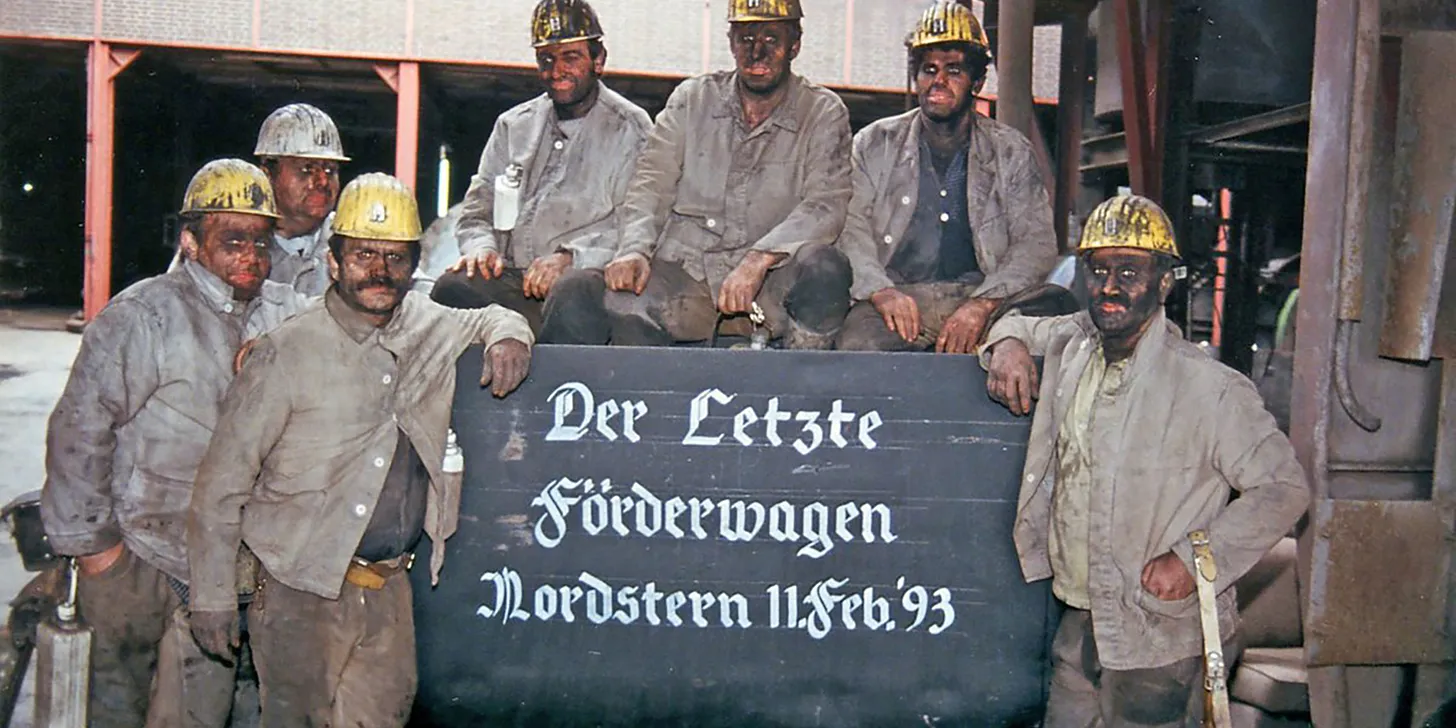
The last mine car. Nordstern Feb '93, 2011
Every time I write about AI and the labor market, someone says it. The phrasing varies, but the sentiment doesn’t. “Coal and steel? You’ve got to be kidding. You’re comparing pickaxes to large language models. It’s not the same thing.”
They’re right. It’s not the same thing. And I want to take that objection seriously, because it sounds serious. Then I want to explain why it’s wrong — and why the impulse to make it is itself the most revealing thing about where we are.
The Wrong Comparison
The objection assumes that what I’m comparing is the industry — coal to AI, physical labor to cognitive labor, a regional economy to a global one. If that were the comparison, the critics would be right to dismiss it.
But the industry is not what I’m comparing. What I’m comparing is the pattern.
I grew up in Gelsenkirchen, in the heart of Germany’s Ruhr Valley. My father was a coal miner. At its peak, the region employed 650,000 people in coal and steel. [1] The mines and foundries weren’t just employers — they were the organizing principle of civic life. The tax base, the social contract, the football clubs, the neighborhood pubs, the whole texture of a functioning society was built around the assumption that coal had a future.
When that assumption broke, everything organized around it broke too. Not all at once. Slowly. The mines closed one by one. Workers were retrained for jobs that were themselves contracting, or for positions that never materialized at the scale promised. Young people left. Services shrank. The tax base eroded. At each stage, the people managing the transition kept measuring, kept retraining, kept insisting the adjustments were working.
Today, Gelsenkirchen has a poverty rate approaching 38 percent, [2] in a country where the national average is 15. Employment in coal and steel across the region fell from 650,000 to 73,000. [1] The city has lost more than 30 percent of its population since my father’s generation worked the mines. [1] Six decades of transition programs, billions in subsidies from European, federal, state, and municipal budgets, a 25-year concentrated push in research and education, and my hometown still has the highest youth welfare dependency rate in Germany. [2]
That’s not a coal story. That’s a story about what happens when the thing a society is organized around stops working, and the people in charge respond with programs calibrated to a crisis that has already moved past them.
The Pattern
In the early 1990s, a German sociologist named Gernot Grabher published research on why the Ruhr failed to adapt. [3] His answer wasn’t that the coal ran out or that the markets shifted — everyone knew that. He answered that the very networks and shared identity that had made the region successful became the barriers to its transformation. He called it cognitive lock-in.
The dense relationships between mining companies, unions, local government, and suppliers — the trust, the shared assumptions, the common identity — had created a closed system. Information that contradicted the prevailing narrative couldn’t get in. People who saw the structural shift coming couldn’t get heard. The consensus culture that had once coordinated an economic miracle now coordinated a slow failure, because the people inside the system couldn’t recognize that the system itself was the problem.
Subsequent researchers confirmed and extended Grabher’s findings. [4] The same tight-knit relationships that made a region powerful also suppressed dissent, discouraged outside perspectives, and created a groupthink so pervasive that managers delayed necessary restructuring, for admitting the model was failing would have threatened their standing within the community. The strength of the bonds became the source of the blindness.
None of this has anything to do with coal. All of it has to do with how concentrated economies fail.
The Monoculture
The Ruhr’s economy wasn’t built on coal. It was built on the assumption that coal would always have value. Everything else — the civic life, the tax base, the social contract — was organized around that premise. When the premise broke, the entire structure broke with it.
The American economy rests on an equivalent premise: that human judgment, analysis, and creative synthesis have enduring market value. The housing market, the education system, the career ladder from entry-level to executive, the consumer spending that drives two-thirds of GDP — all of it is organized around the assumption that knowledge work will always exist. That’s the monoculture. Not the specific jobs. The underlying assumption on which the whole structure rests.
Knowledge doesn’t have to be coal for the pattern to hold. It just has to be the thing the whole structure depends on. And it is. AI is what breaks the assumption — the way cheap imports broke coal. When AI writes legal briefs, generates architectural plans, produces code, and drafts marketing strategy, it’s not replacing one category of labor the way machines replaced physical work. It’s undermining the premise that organized the entire professional economy: that moving up the value chain — getting more education, developing better judgment, learning to do what machines couldn’t — was a reliable path to economic security.
The Ruhr told its workers to adapt, retrain, and move into services. There was at least somewhere to go, even if the destination paid less. The research on the Ruhr documents how that requalification model worked — and where it fell short. But it at least had a destination. When AI automates the destination itself — when the “higher-skill” roles that displaced workers are supposed to retrain into are themselves being absorbed — the requalification logic falls short. It collapses. The pattern traveled from the shaft to the office without anyone noticing the route.
The Dismissal as Symptom
Here’s where this gets uncomfortable, because the “coal and steel” dismissal isn’t just an intellectual disagreement. It’s a textbook case of the very dynamic the research describes.
Cognitive lock-in doesn’t look like ignorance. It looks like sophistication. It’s the belief that because your situation is technically unprecedented, the structural patterns observed in other contexts can’t possibly apply. It’s the confidence that comes from being embedded in a network of people who share your assumptions, read the same sources, attend the same conferences, and reinforce each other’s conviction that this time is different.
The Ruhr’s industrial leaders believed that too. Coal and steel had powered Germany’s economic miracle. The region had the best engineers, the densest networks, and the most productive facilities in Europe. When cheaper imports started arriving, the response wasn’t panic — it was confidence. The Ruhr was too important, too integrated, too essential to the national economy to fail. The transition would be managed. The workers would adapt. The fundamental structure was sound.
They were wrong. Not because they were stupid, but because they were locked in. The information contradicting their model couldn’t penetrate the networks shaping their worldview.
“Coal and steel, you’ve got to be kidding.” is that same lock-in, performing itself in real time. It assumes that because AI is technically novel, the social and economic dynamics surrounding it must also be novel. But the dynamics are not novel. They are documented, studied, and recurring. The specific industry changes every time. The monoculture changes. The technology changes. The pattern doesn’t. And the most consistent feature of the pattern — across the Ruhr, across the American Rust Belt, across British coal towns — is that the people inside it are certain their situation is unique. That certainty is what prevents adaptation. It’s what Grabher identified in 1993, and it’s what the dismissal enacts without recognizing it.
This is not an argument by analogy. It’s an argument from structural pattern recognition. And the strongest evidence for its validity is that the people who dismiss it are exhibiting the very behavior the pattern predicts.
Convergence
In March 2026, The Atlantic published a long investigation titled “America Isn’t Ready for What AI Will Do to Jobs.” [8] The reporter spent months interviewing Federal Reserve presidents, Nobel Prize-winning economists, Fortune 100 CEOs, union leaders, and politicians, from Bernie Sanders to Steve Bannon. The piece arrived at the same diagnosis from a completely different direction — not through the Ruhr, not through structural pattern recognition, but through the direct testimony of the people running the system. The economists can’t see it in the data yet. The CEOs have stopped talking publicly because they know what’s coming, and their PR teams have told them to shut up. Congress is structurally incapable of responding. And the institution designed to measure what’s happening to American workers — the Bureau of Labor Statistics, created in the 1880s because the republic believed it had a duty to count — is being defunded.
The Atlantic piece doesn’t mention Gelsenkirchen, Grabher, or cognitive lock-in. It doesn’t need to. It documents the same pattern from the inside: a system that can see the disruption arriving and cannot organize a response. When a retired web developer from a German mining town and a months-long investigation by one of America’s oldest magazines arrive at the same conclusion independently, the conclusion is probably not the problem. The question is why so few people with the power to act are willing to hear it.
What the Ruhr Actually Proves
Germany did everything right — or as close to right as any capitalist democracy has managed. Co-determination laws gave workers seats on corporate boards. [6] The constitution mandated equivalent living conditions across regions. [5] Statutory pension and unemployment insurance funded early retirement without catastrophic income loss. A consensus culture between industry, unions, and the state coordinated the transition over six decades. Billions flowed in from European, federal, state, and municipal budgets. Universities were built. Science parks were constructed. [7] The region rebranded itself twice.
And it still produced 38 percent poverty in Gelsenkirchen. [2] Still left the region with nearly double the national unemployment rate. [9] Still lost 30 percent of the population. [1] Still created a Social Equator — the A40 motorway — dividing the prosperous south from the stagnant north, with world-class infrastructure on both sides and radically different lives beneath. [9]
That’s not a failure story. It’s the success story. It’s the best-case outcome for a managed industrial transition in a society with strong institutions, robust safety nets, and sustained political will. If the best version of managed transition, executed by a society purpose-built for social partnership, still produces generational poverty in the communities at the center of the disruption — what does that tell us about a country with none of those institutional advantages facing a disruption that’s faster, broader, and not geographically contained?
The United States has no co-determination framework. No constitutional mandate for regional equity. Union membership is at a historic low. A social safety net that has been deliberately weakened for four decades. A political system where the industries that need regulation fund the legislators responsible for regulating them. Two-year election cycles are structurally incapable of addressing decade-long disruptions. And a deeply embedded cultural narrative that market intervention is suspect and individual adaptation is the only legitimate response to structural change.
The Ruhr comparison doesn’t just show what slow collapse looks like. It shows the minimum institutional requirements for managing that collapse — and, by extension, how far the United States is from meeting them.
Not a History Lesson
I didn’t study this in a textbook. I grew up inside it. I watched the same confident assurances play out over decades — the transition is being managed, the retraining is working, the numbers will improve. I watched “not yet” become “too late” over the span of a childhood. And the people who dismissed the warning signs weren’t stupid or malicious. They were locked in. They couldn’t see the pattern because they were inside it.
The person who says “coal and steel, you’ve got to be kidding” is inside it now. They can’t see the pattern because the technology is too dazzling, the networks too affirming, the narrative too compelling. AI is unprecedented. This time is different. The old lessons don’t apply.
The old lessons always apply. That’s what makes them lessons.
Sources
[1] Urban Transitions Alliance, “Gelsenkirchen city profile.” Regional employment decline (650,000 to 73,000) and 30%+ population loss.
[2] Paritätische Armutsbericht (Paritätische Poverty Report), 2024. Reports a 37.9% poverty rate for Gelsenkirchen. Youth welfare dependency data from the Bremen Institute for Workplace Research and Career Support.
[3] Gernot Grabher, “The Weakness of Strong Ties: The Lock-in of Regional Development in the Ruhr Area,” in The Embedded Firm: On the Socioeconomics of Industrial Networks, edited by Gernot Grabher, Routledge, 1993. Cognitive lock-in theory.
[4] Pillai et al, “The Negative Effects of Social Capital in Organizations: A Review and Extension.” Research on bonding social capital as a barrier to adaptation, including groupthink, suppression of dissent, and delayed restructuring.
[5] Article 72 of the German Basic Law (Grundgesetz). Establishes the principle of “equivalence of living conditions” (gleichwertige Lebensverhältnisse) across regions. The Joint Federal/Länder Task for the Improvement of Regional Economic Structures (GRW) is the primary fiscal mechanism.
[6] German Co-determination Act (Mitbestimmungsgesetz), 1976, and the earlier Montan Co-determination Act (Montanmitbestimmungsgesetz), 1951. Worker representation on supervisory boards in coal and steel industries.
[7] Ruhr transition policy phases. Taxonomy of preserving, reactive, and forward-looking structural policy drawn from academic literature on the Ruhr transition. Science Park Gelsenkirchen from municipal development records. IBA Emscher Park and Zollverein UNESCO World Heritage designation.
[8] Josh Tyrangiel, “America Isn’t Ready for What AI Will Do to Jobs,” The Atlantic, March 2026. Interviews with Austan Goolsbee, Daron Acemoglu, David Autor, Anton Korinek, Reid Hoffman, Gina Raimondo, Liz Shuler, Senator Gary Peters, Senator Bernie Sanders, and Steve Bannon. BLS funding and survey limitations from former commissioner Erika McEntarfer.
[9] “Regional analysis of structural change in the German hard coal mining Ruhr area.” A40 motorway as socioeconomic dividing line; Gelsenkirchen unemployment rate of 14.7% versus national average of 5.5%.
Earlier essays in this series: “Who Buys What We Build?”, “I’ve Seen This Before,” “The Corporate Benevolence Fantasy,” and “Not Yet,” Werner Glinka, Substack, 2025–2026.