
Palo Alto Weekly
When Opposites Converge
Sept 2009 by Lauren Jo
It could be a flower, made with industrial materials to illustrate the intersection between man and nature. Or, it could just be pieces of chicken wire rolled up and attached to a canvas. That's up for debate.
Industrial artist Werner Glinka refuses to title his mixed-media assemblages lest he influence viewers' interpretations. From rusty metal bands and chicken wire to small twigs and ashes from his fireplace, he mixes recycled industrial materials with natural resources to create a minimalist aesthetic that highlights both.
"I was always drawn to simple things," the artist said in a recent interview at his studio at the 1870 Art Center in Belmont. "I think from birth I was a minimalist."
Glinka's approach to his art is simple as well, with his curiosity leading the way. "It's driven by instinct, really," he said of his creative process. "It's probably a benefit that I didn't go to art school... I approach things completely naive." Uninhibited by preconceived notions of what one can or cannot use in art, he is free to experiment with tools, techniques and materials such as heat lamps and pearls.
Several examples are currently on exhibit through Sept. 24 as part of Stanford Art Spaces at the Paul G. Allen Building on campus. Glinka is showing pieces from various series that he works on concurrently - urban totems, rust paintings and visual mantras, to name a few. They're shown alongside paintings by Nancy Eckels and Asha Menghrajani.
An unconventional gallery space, the meandering, multi-story Paul G. Allen Building is home to the Center for Integrated Studies. Set against the backdrop of researchers in clean-room suits working under neon yellow lights, the elaborate textures and geometric shapes in Glinka's art come to the fore.
Working as a marketing executive, electrical engineer, and graphic designer for more than 25 years, Glinka has a natural affinity for functional, industrial design and simplicity. The artist read books on Bauhaus, the 20th-century German art and design school whose style heavily influenced Modernism. From trips to Japan, he picked up on the simplistic Japanese style, particularly that of designer Tadao Ando and his spartan homes of glass, steel and concrete.
For a minimalist, Glinka creates art brimming with tension between the opposing forces of man and nature, order and decay, geometry and irregularity — a dual aesthetic born of the two contrasting settings in which he has lived. Currently living in Woodside, the artist is from the industrial town of Gelsenkirchen, Germany, where he found inspiration in coal mines and steel plants. "You discover beauty in other things," he explained. "For example, I see beauty in rust," he said. After immigrating to the United States in 1981, Glinka began creating his distinctive assemblages when he moved to Woodside. There he unearths the beauty in natural materials, too, such as sand from Skyline Boulevard and leaves that have dried in the sun. A Madrone leaf inspired his first solo exhibition, "Fallen Leaf," shown at the Woodside Library in 2001.
The influences from these disparate worlds create a palatable tension in Glinka's art. Some pieces feature what looks like cracked, dried mud; others boast pipes or concrete, and some appear to elevate a single leaf.
"When out in nature," he said, "I want to be completely quiet and immerse myself in the beauty, but there's this constant struggle." Reminders of e-mails, meetings and bills intrude on the serenity. And although he lives in leafy Woodside, the tech world is only minutes away.
"It is as if ... he were creating nano-chips out of leaves and twigs," said Claudia Morgan, associate dean of Stanford's Graduate School of Business and former president of the Pacific Art League.
Glinka's intriguing combination won favor with the board members of the 1870 Art Center who reviewed his application for a studio at the artist community. On the site of a former school, the center provides workspaces and an established gallery.
"If it came to what I would write a big check for, it would be one of his where he's built a structure on top of a surface where he's used metal strips," art center founder and director Ruth Waters said in a phone interview. "He has cut and attached them and created designs that are extremely interesting to me."
One piece in the current Stanford exhibit is "Circular Object 711," a structure of interwoven metal bands — some rusted, some shiny — attached to a dark panel. Glinka said many of his assemblages come alive with the proper lighting, which throws intricate shadows and reveals complex textures, reflections and colors.
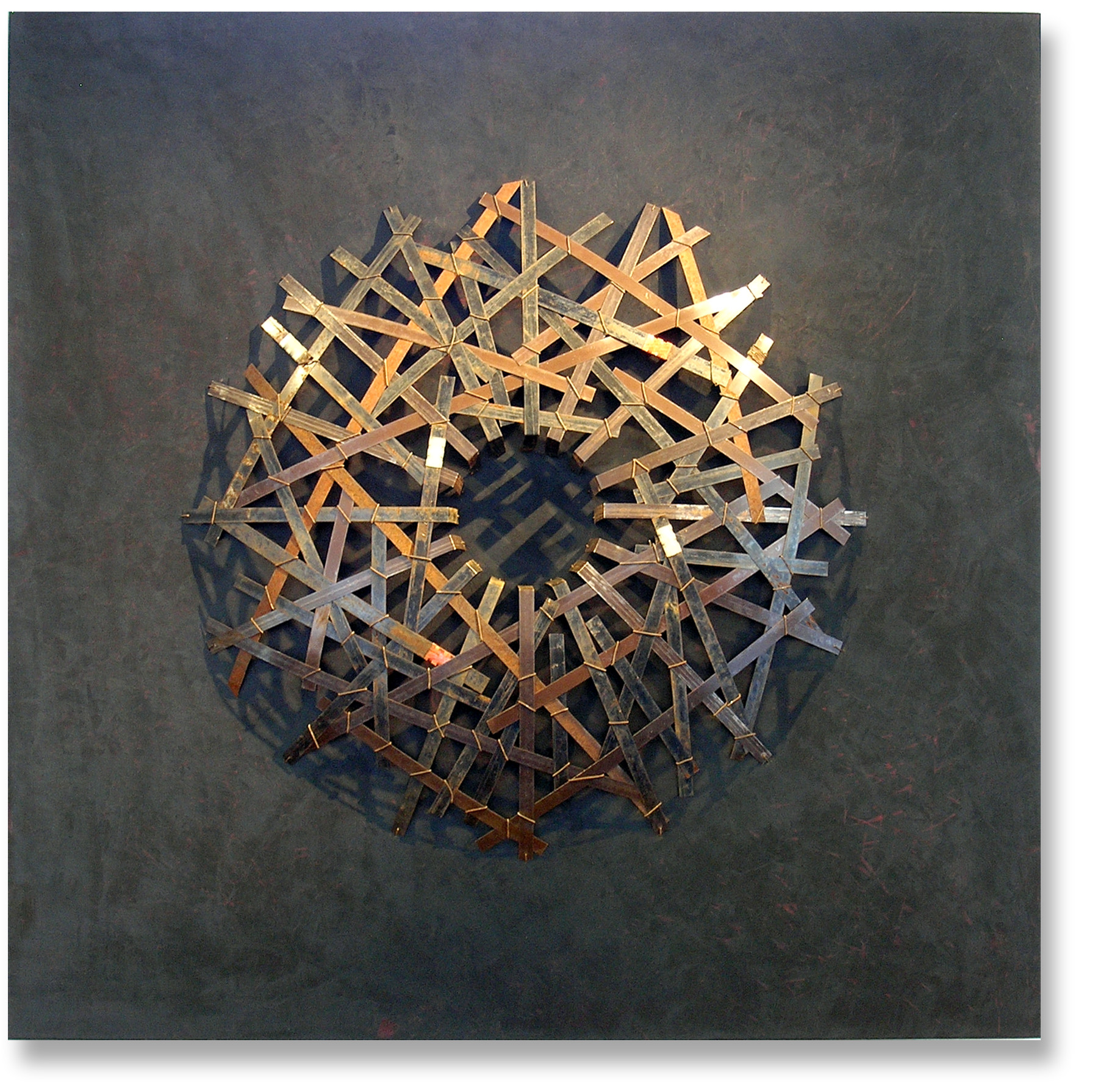
He calls some of the pieces "vessels." "They're like the underneath and ribbing and structure of a boat," Waters said. "They're distinctive. No one knows really what he's doing.
Glinka has always dabbled in art for pleasure. Unable to afford fine art in college, such as Alexander Calder's mobiles, he made his own assemblages.
But art took a back seat to work until he moved to the Kings Mountain area and volunteered at the annual art fair, prompting him to return to the craft. He left his marketing executive position at Hitachi America in 1999, staying on as a consultant. Newly autonomous, he found himself in the studio half the time and has since considered himself an artist.
In 2005, he founded German American Artists with Ines Tancre and Palo Alto artist Inge Infante to promote German immigrant artists. Most of the group's 12 artists are based in the Bay Area, and a shared understanding of the immigrant experience ties them together.
"When you grow up in a culture, and you go to another culture, you don't feel at home," he said. "There's this tug of war you never resolve."
Glinka, who served on the board of directors at the Pacific Art League for three years, has shown his work at venues throughout the Bay Area, including the art league and the Mountain View Center for the Performing Arts. In 2007, he exhibited at the German Consulate General in San Francisco as part of "Berlin and Beyond," an annual film festival that features the latest in cinematic art from Germany, Austria and Switzerland. He prepared pieces most recently for the Kings Mountain Art Fair.
With three exhibitions completed this year, the industrious artist is now in his "chill-out phase" and plans to return to work in October, hoping to revisit his three-dimensional wall sculptures and pieces with more vibrant color. With all the opposing forces in his life, Glinka finds harmony in pursuing art.
"It is less the final result - it is more the process of creating," he said. "It creates balance in my life."